Morris Goodman — Cathy Goodman
The SecretMorris Goodman — Cathy Goodman is a spousal relationship used in The Secret to connect two first-person healing testimonies. Morris’s survival after a devastating airplane crash and Cathy’s account of recovering from breast cancer are presented as complementary demonstrations of the mind’s supposed power over the body, with their marriage providing an intimate context for the book’s language of faith, gratitude, laughter, and recovery.
Identity and Shared Narrative
Morris Goodman is identified as an author and international speaker known as “The Miracle Man.” His story became part of The Secret because it dramatizes the book’s central claim that the human mind possesses “unfathomable power and unlimited potential.” Cathy Goodman is likewise featured in The Secret, where she tells her own account of self-healing. The available material does not describe their courtship or domestic life, but it explicitly identifies them as husband and wife and places their individual experiences within one shared inspirational framework.
Their stories differ in circumstance but converge in interpretation. Morris’s narrative begins with physical catastrophe and medical predictions of permanent incapacity; Cathy’s begins with a diagnosis of breast cancer and a deliberate effort to cultivate gratitude, faith, and joy. Read together, the accounts move from emergency and bodily damage to intentional mental focus, making the marriage a bridge between two forms of testimony rather than merely a biographical detail.
Morris Goodman’s Crisis and Recovery
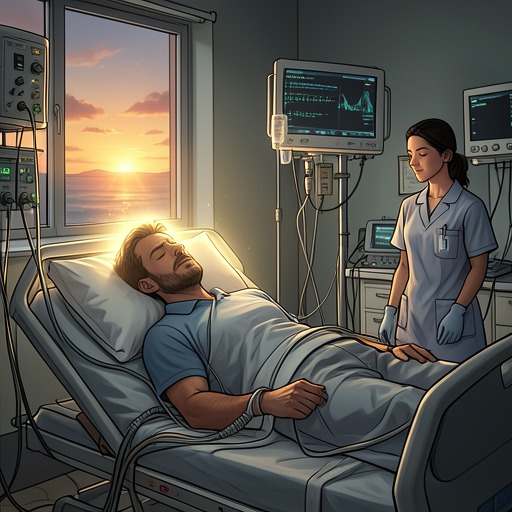
On March 10, 1981, Morris Goodman crashed an airplane and was taken to the hospital completely paralyzed. His spinal cord was crushed, his first and second cervical vertebrae were broken, his swallowing reflex had been destroyed, and he could neither eat nor drink. His diaphragm was also destroyed, leaving him unable to breathe; according to his account, all he could do was blink his eyes. Doctors told him that he would remain a vegetable for the rest of his life and would never function normally.
Morris’s response was to construct a contrary image of the future. Although the doctors saw irreversible damage, he pictured himself as a normal person again, walking out of the hospital. He describes the mind as the only resource available to him and treats that resource as sufficient to begin putting the body back together. While attached to a respirator, he repeatedly heard an inner command to breathe deeply. Eventually he was weaned from the respirator, a development that left the medical staff at a loss for an explanation.
He then fixed his recovery to a specific goal: walking out of the hospital on Christmas. He did so on his own two feet, despite the prediction that it could not be done. The date and the physical act give his testimony its decisive shape. The account is not presented as a gradual clinical report but as a concentrated sequence of catastrophe, visualization, disciplined attention, reversal, and apparently miraculous release.
Cathy Goodman’s Healing Practices
Cathy Goodman’s testimony centers on a diagnosis of breast cancer. She says that she believed in her heart that she was already healed and repeated the words “Thank you for my healing” day after day. Her practice joins gratitude to visualization: she saw herself as though cancer had never been in her body. In the logic of The Secret, the imagined state of health is treated as an active condition rather than a distant hope.
Laughter became the practical form of that belief. Cathy and those around her watched very funny movies and laughed repeatedly, because they believed that stress was among the worst influences during healing and that they could not afford to allow it into her life. Her story therefore adds a social and ritual dimension to the mind-centered account: recovery is represented not only as private concentration but also as a shared atmosphere organized around humor, gratitude, and the refusal to dwell on fear.
The book explicitly links Cathy’s use of laughter to Norman Cousins’s story. Cousins had been diagnosed with an “incurable” disease and was told that he had only a few months to live. He watched funny movies and laughed for three months, after which the disease left his body and doctors proclaimed his recovery a miracle. Cathy’s testimony thus appears as an inspired continuation of an earlier healing narrative, with laughter functioning as the recurring practice that carries the idea from one patient to another.
Belief, Medicine, and the Body
The relationship is embedded in a broader argument that the body is shaped by thought and emotion. The discussion of the placebo effect presents a sugar pill as something supposedly without direct bodily impact that can nevertheless produce the same effect as medication when a patient believes it is effective. The mind is consequently described as a major factor in healing, sometimes more influential than the medication intended to produce the result.
The text does not entirely reject medicine. It acknowledges that in an acute situation capable of causing death, medicine is wise, and it says that every form of healing has a place. Pain medication may help a person focus more forcefully on health, allowing mental practices to operate alongside conventional treatment. This qualification places the Goodmans’ stories within a model of harmony between medicine and belief, even though the surrounding rhetoric repeatedly gives thought the leading causal role.
The same framework interprets bodily symptoms as feedback about an imbalanced perspective or a failure to be loving and grateful. It urges readers to think of perfect health, to observe perfection rather than illness, and to avoid constantly discussing disease. The proposed discipline is to see oneself as healthy, speak words associated with wellness, and redirect conversations about illness toward good things or toward an imagined image of the sick person restored to health.
Narrative Significance and Limits
Morris’s recovery is the larger public emblem of the relationship’s narrative function. The book calls him “The Miracle Man,” says that his story has inspired thousands to imagine and feel their way back to health, and interprets his greatest challenge as his greatest gift. His six-word summation, “Man becomes what he thinks about,” condenses the philosophy that Cathy’s repeated thanks, cancer-free visualization, and laughter enact in a different register.
Together, the two testimonies create a persuasive progression. Morris supplies an extreme test in which paralysis, respiratory failure, and medical pessimism are overcome through a fixed vision of walking again. Cathy supplies an intimate practice in which gratitude and comic pleasure are made into daily defenses against fear and stress. Their marriage allows the book to present these not as isolated stories but as related evidence within a shared world of healing belief.
The accounts remain inspirational testimonies rather than controlled medical evidence. The material gives diagnoses, predictions, practices, and reported recoveries, but it does not provide clinical measurements, comparison groups, or a complete account of concurrent treatment. Their significance within The Secret therefore lies chiefly in narrative and rhetorical force: Morris and Cathy Goodman embody the book’s conviction that healing begins with the image, feeling, and expectation a person sustains, while the text’s medical claims extend beyond what these individual stories alone can establish.